
To make bug-free MLM software, focus on three critical areas: define and test every business rule before development, build the software with a modular and testable architecture, and perform automated plus scenario-based testing before deployment. Pay special attention to MLM income calculations, genealogy structures, rank rules, wallet transactions, and edge cases because these are the areas where small development errors can create major financial problems.
When I first started making MLM software in 2016, I loved how it is so simple to make money in programming. I started with making an ICO and single leg plan, which typically take 5-7 days to finish, and within 10 days, I get paid from the client. Fiverr was the best platform to get clients at that time. Life was beautiful; my bank balance and I were growing together.
When I earned some experience, I started taking bigger projects like binary, matrix reverse 1 up, etc. Although understanding these difficult plans and building them was a challenge at that time (because ChatGPT and AI tools were not yet developed), I still took the risk because the project money was huge. It took 20 days to build binary income when I built the project for the first time in Codeigniter.
I finally finished the project anyhow, using my brain and Stack Overflow, but within 2-3 days of launching, I was getting messages from the client that the incomes were not working correctly. I checked the system and didn’t find any clue about what was happening. After spending late nights debugging deeper and deeper, I managed to fix the bugs after several days, but the experience was very bad. The money is now becoming bloody money.
From God’s grace, I am a book lover and read a lot of self-help books. When your time is great, good things come your way automatically, same happened with me. I found something called a system. I learned what the system is and how to use it in my development career. Here is a definition for your understanding. The system is a step by step process of doing something. It is everywhere, if you turn on your computer or mobile, dozens of programs get started, but it is your operating system who ensures that the first step always performs before second to smoothly turn on your computer or mobile. In the same fashion, we should follow a step by step process to make bug free MLM so we can enjoy our weekends, otherwise your phone will keep ringing and no matter whether you pick it or not, your focus will always be there. I can feel the pain because it happened to me multiple times.
So enough talk, here is a process that you must follow, and I bet you will never get complaints from customers, just make the project and enjoy the money without any guilt or frustration.
The 3-Step Guide
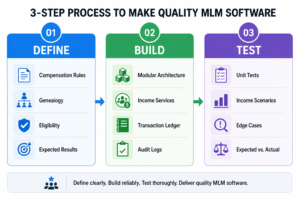
In this guide, I will explain a practical 3-step process for making quality MLM software that is easier to develop, test, maintain, and scale.
We will also discuss:
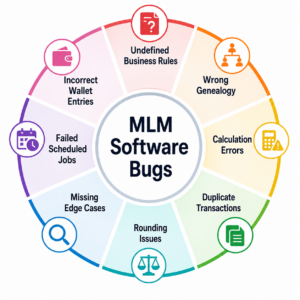
- Why does MLM software develop bugs
- How to document a compensation plan before coding
- How to test MLM income calculations
- How to test genealogy and downline structures
- How to create automated test scenarios
- How to make MLM software faster without sacrificing quality
- How to test Direct Income, Level Income, ROI, Matching Income, Rank Bonus, and other commissions
- How to create MLM software that can handle real-world edge cases
Let’s start with the most important principle:
Bug-free MLM software starts before the first line of code is written.
Why Is It Difficult to Make Bug-Free MLM Software?
MLM software is fundamentally a rule-driven financial application.
A typical MLM platform may need to manage:
- User registration
- Sponsor relationships
- Placement relationships
- Genealogy trees
- Product purchases
- Package activation
- Wallet balances
- Deposits and withdrawals
- Commission calculations
- Rank qualifications
- Payout processing
- KYC verification
- Tax deductions
- Administrative adjustments
The complexity increases when the compensation plan includes multiple income types.
For example:
- Direct Referral Income
- Level Income
- Binary Income
- Matching Income
- ROI Income
- Rank Bonus
- Leadership Bonus
- Gap Level Income
- Pool Income
- Generation Income
- Repurchase Income
Each income type may have completely different eligibility conditions.
Consider a simple rule:
A member receives 10% Direct Income when a personally sponsored member purchases an eligible package.
It sounds straightforward. But a developer still needs answers to several questions.
- What happens if the sponsor is inactive?
- What happens if the new member upgrades the package later?
- Does the commission apply to the entire package amount or only the business volume?
- Can the same package generate Direct Income twice?
- What happens if the payment is refunded?
- When should the commission enter the wallet?
- Is there a maximum earning limit?
- Does the sponsor need to complete KYC before receiving the income?
These questions illustrate one of the biggest reasons MLM applications develop bugs:
The business rule is usually more complicated than the initial requirement suggests. Therefore, if you want to understand how to make quality MLM software, you first need to understand the complete business logic before implementing it.
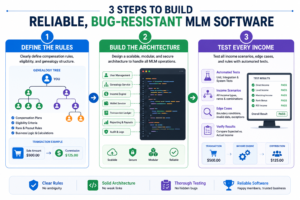
The 3-Step Guide to Make Bug-Free MLM Software
The following three-step framework can significantly improve the quality and reliability of an MLM software project.
Convert the MLM Compensation Plan Into Testable Business Rules
The first step to making bug-free MLM software is not programming. It is requirements engineering. Before developers create database tables, APIs, dashboards, or commission algorithms, the complete MLM compensation plan should be converted into clearly defined business rules.
Complete MLM compensation plan should be converted into clearly defined business rules.
A compensation plan document may say:
Members receive 5% income up to 10 levels.
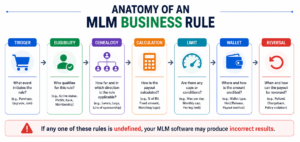
This is not enough information for a developer. A testable requirement should explain:
- Who is eligible?
- When will the income be credited to the sponsor’s wallet?
- How is the income calculated?
- Which genealogy relationship is used?
- What conditions can stop the income?
- Is there a maximum cap?
- Can the transaction be reversed?
The objective is to remove ambiguity before development starts.
Create a Rule Matrix for Every MLM Income
| Rule | Direct Income Example |
|---|---|
| Trigger | A new member purchases an eligible package |
| Beneficiary | Direct sponsor |
| Calculation | 10% of the eligible amount |
| Eligibility | Sponsor must be active |
| Maximum Limit | Defined by package or plan |
| Credit Timing | After successful payment |
| Reversal | Required if the transaction is refunded |
| Wallet | Commission wallet |
Document the Genealogy Logic
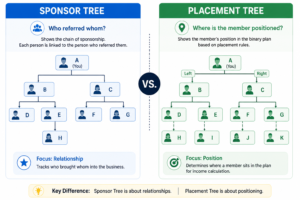
One common source of bugs in MLM software is confusion between sponsor genealogy and placement genealogy. These relationships may look similar but serve different purposes.
A sponsor relationship usually represents: Who referred the member?
A placement relationship may represent: Where is the member positioned in the network?
Depending on the MLM compensation plan, different income calculations may use different trees. For example, Direct Income may depend on the sponsor relationship, while Binary Income may depend on placement in the left or right leg.
If developers use the wrong genealogy relationship, the software may technically execute successfully while still producing incorrect payouts.
That is one of the most dangerous types of software bugs.
- The application works.
- The database works.
- No error appears.
- But the business result is wrong.
Therefore, genealogy rules must be explicitly documented.
Create Examples Before Creating Algorithms
For every commission rule, create manual examples. Suppose: User A sponsors User B, User B purchases a ₹10,000 package, Direct commission is 10%.
Expected result: User A receives ₹1,000.
Now increase the complexity. Suppose: User A sponsors User B, User B sponsors User C, User C purchases a ₹10,000 package, Level 1 commission = 10%, Level 2 commission = 5%.
Expected result: User B receives ₹1,000, User A receives ₹500.
Next, introduce exceptions. What if User B is inactive? Should User A still receive Level 2 Income? Should the income skip User B? Should the entire commission stop?
The correct answer depends on the compensation plan. The important point is that the answer should be defined before coding begins.
If you’re thinking that it is huge, then my friend, you’ve to remember that if you pay attention here, you’ll save your nights and weekends; otherwise, you’ve to keep fixing and hear abuse from clients. BTW, I’ll provide you with documents that you can use throughout building the project.
Build an Expected-Result Dataset
If you are researching how to make bug-free MLM software, this is one of the most valuable practices you can implement. Create a spreadsheet containing: Test user, Sponsor, Placement, Package, Rank, Status, Transaction, Expected income, Actual income, Pass/Fail result.
This creates a source of truth. Your developers can build the logic, and your QA team or client can compare the application’s results against manually verified expected results.
Free MLM Income Testing Spreadsheet
We have also prepared a Google Docs/Spreadsheet-based MLM Income Testing resource that you can use to test different types of MLM income calculations. You can use it as a starting point to document and verify calculations such as: Direct Income, Level Income, ROI Income, Gap Level Income, Rank Bonus, Matching Income. Instead of testing commissions randomly, the document helps you create structured test scenarios with expected and actual results.
Get the MLM Income Testing Google Sheet/Document
Build MLM Software With a Modular and Testable Architecture
Once the compensation rules are clearly defined, the second step is to design the application correctly. If you want to know how to create MLM software that remains reliable as the business grows, avoid putting the entire compensation logic into one massive function.
For example, an MLM application should ideally separate different responsibilities. You may have independent modules or services for: User management, Genealogy management, Package management, Order management, Wallet management, Commission calculation, Rank calculation, Payout processing, Notifications, Reporting.
Income calculation should also be modular. For example: Direct Income Service, Level Income Service, Matching Income Service, ROI Income Service, Rank Bonus Service.
The exact technical architecture will depend on your programming language and framework, but the principle remains the same: Each important business rule should be independently understandable and testable.
Why Modular MLM Software Is Easier to Debug
Suppose the total wallet balance is incorrect. In a poorly structured application, developers may have to inspect thousands of lines of interconnected code. In a modular system, the investigation can be narrowed down. Was the problem caused by: Direct Income? Level Income? ROI? Wallet credit? Transaction reversal? This makes debugging significantly faster.
Treat Every Commission as a Financial Transaction
Another important principle for making quality MLM software is maintaining a proper transaction history. Avoid treating wallet balance as simply a number that can be modified without explanation. Every credit or debit should ideally have a corresponding ledger entry containing information such as: User ID, Income type, Source transaction, Source member, Amount, Debit or credit, Date and time, Status, Reference ID.
This creates traceability. If a distributor asks: “Why did I receive this commission?” — Your system should be able to answer that question. Similarly, if an administrator asks: “Why is this wallet balance ₹5,000 higher than expected?” — The development team should be able to trace every transaction contributing to that balance.
Prevent Duplicate Income
Duplicate commission processing is a critical problem in financial applications. Imagine that a payment confirmation event is accidentally processed twice. Without proper protection, the software may credit the same commission twice. Therefore, commission transactions should be designed to be idempotent wherever appropriate. In simple terms: Processing the same qualifying event twice should not accidentally create two identical commissions.
Developers can achieve this through techniques such as: Unique transaction references, Database constraints, Processing status, Idempotency keys, Event logs. The exact implementation depends on the architecture, but duplicate prevention should be part of the original design.
Handle Database Transactions Carefully
Consider a package purchase that triggers: Package activation, Direct Income, Level Income, Rank update, Wallet credit. What happens if the first three operations succeed but the fourth operation fails?
You may end up with partially processed data. This is why critical operations should be designed with transaction integrity and failure recovery in mind. Financial and commission-related operations should never leave the system in an unknown state.
Never Use Floating-Point Calculations for Money
Another important technical consideration is monetary precision. Financial calculations should use appropriate decimal or fixed-precision data types. This becomes especially important when: Percentage commissions are calculated, Currency conversions occur, Multiple levels receive fractional amounts, Tax or service charges are deducted. Even tiny rounding differences can become significant when thousands of transactions are processed.
Your compensation plan should also explicitly define the rounding policy. For example: Round to two decimal places, Round at each commission level, Round only after total calculation. These decisions should not be left to chance.
Maintain an Audit Trail
A quality MLM platform should record important financial and administrative actions. Examples include: Package activation, Package upgrade, Commission generation, Wallet adjustment, Withdrawal approval, Rank change, User status change, Administrative changes.
An audit trail helps with debugging, customer support, financial reconciliation, and accountability.
Test Every MLM Income With Automated & Scenario-Based Testing
The third and perhaps most important step in understanding how to make bug-free MLM software is comprehensive testing.
Clicking through the admin panel is not enough. MLM software needs business logic testing. You should test every income individually before testing the entire compensation plan.
How to Test Direct Income
Create scenarios such as: Scenario 1: A sponsors B. B purchases an eligible package. Expected result: A receives the correct Direct Income. Then test exceptions: A is inactive, B’s payment fails, B’s transaction is refunded, B upgrades the package, The same event is processed twice.
Every scenario should have a clearly defined expected result.
How to Test Level Income
Create a controlled genealogy. For example: A → B → C → D → E. Then activate E. Calculate manually how much income should reach: D, C, B, A. Compare the manually calculated result with the software-generated result. Next, introduce edge cases. What happens if: C is inactive? B is blocked? A has reached the maximum earning cap? D has not completed the required qualification?
This is where many MLM income bugs become visible.
How to Test ROI Income
ROI-based calculations require careful testing because they are often time-dependent. Test: ROI start date, ROI end date, Daily or periodic percentage, Maximum ROI limit, Non-working days (if applicable), Package expiry, User blocking, Package upgrades, Duplicate cron execution.
One particularly important test is running the same scheduled process twice. The second execution should not accidentally generate duplicate ROI Income.
How to Test Matching Income
Matching Income can become complicated because it may depend on income earned by downline members. You need to test: Eligible income source, Matching percentage, Eligible generations, Rank requirement, Maximum matching limit, Inactive users, Income reversal. Create a fixed network and manually calculate the expected matching amount. Then compare it with the application output.
How to Test Rank Bonus
Rank calculations should be tested independently from Rank Bonus payments. A user may qualify for a rank based on: Personal sales, Team sales, Direct referrals, Qualified legs, Downline ranks. Create test cases for: Just below qualification, Exact qualification, Above qualification, Qualification after refund, Qualification after downline deactivation.
Boundary testing is extremely important here. If the required business volume is 10,000, test: 9,999, 10,000, 10,001. This simple approach can uncover comparison errors that ordinary testing may miss.
Test Real-World MLM Edge Cases
The question is not only how to make quality MLM software when everything works perfectly. You must also ask: What happens when something unexpected happens? Test scenarios such as:
Package is refunded
Payment callback arrives twice
Cron job runs twice
Member becomes inactive
Member is blocked
Rank decreases
Package expires
Wallet transaction fails
Withdrawal is rejected
Admin manually adjusts balance
User reaches maximum income cap
Downline structure contains thousands of members
These situations may not occur every day, but they can expose serious weaknesses in the system.
How to Make MLM Software Fast Without Creating More Bugs
People searching for how to make MLM software fast may be asking two different questions: How can MLM software be developed quickly? How can MLM software run faster? Let’s address both.
How to Develop MLM Software Faster
The wrong way to accelerate development is to skip requirement analysis and testing. This usually saves time initially but creates more work later.
A better approach is to standardize reusable components, make separate service files for each of the feature. A car manufacturing companies build steering, gearbox separately and put it in all the vehicles that they make, we also take inspiration from it. Make service files in a way so you can use it in any project by just copy paste. For example: Authentication, KYC, User management, Direct Income, Level Income, Payment processing, Notifications, Reporting. Then build compensation-plan-specific modules separately.
You can also accelerate development by creating reusable test templates.
Every time a new income type is added, developers should already know which scenarios need to be tested. This allows the team to move faster without compromising quality.
How to Improve MLM Software Performance
As an MLM network grows, genealogy queries can become expensive. For example, repeatedly calculating an entire downline tree from scratch may become slow when thousands or millions of relationships exist. Performance optimization may include: Proper database indexing, Efficient genealogy data structures, Query optimization, Caching, Background job processing, Queues, Batch processing, Pagination, Precomputed statistics.
However, optimization should be based on actual performance measurements. Do not introduce unnecessary architectural complexity simply because the software might become large in the future. Build for your realistic scale, measure bottlenecks, and optimize accordingly.
The Most Important Rule: Test Expected Income vs. Actual Income
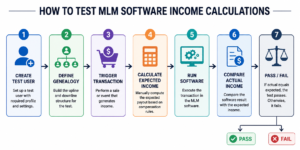
If I had to summarize how to make bug-free MLM software in one testing principle, it would be this: For every income calculation, define the expected result manually and compare it with the result generated by the software. Use the sheet I provided as reference.
Do not rely only on whether the page loads successfully.
Do not rely only on whether a commission was generated.
Ask:
Was the correct commission generated for the correct person, for the correct reason, at the correct time, and for the correct amount?That is the real test.
This is exactly why we recommend maintaining a dedicated MLM Income Testing spreadsheet. You can create scenarios for:
For every scenario, record:
Rule
Expected Result
Actual Result
Pass/Fail
Download/Access Our MLM Income Testing Google Sheet
Your developers and testers can use the document as a reusable testing framework instead of manually inventing test cases every time.
A Practical MLM Software Quality Checklist
Before launching your MLM software, verify the following.
Compensation Plan
Genealogy
Income Testing
Financial Integrity
Security
Performance
Deployment
Final Thoughts: How to Make Quality MLM Software
Creating reliable MLM software is not about writing more code. It is about eliminating ambiguity. The most effective three-step process is:
- Define — Convert every compensation-plan rule into clear, testable scenarios.
- Build — Use modular architecture, traceable financial transactions, duplicate prevention, and reliable data handling.
- Test — Test every income independently using manually verified expected results, automated tests, and real-world edge cases.
If you follow this approach, you dramatically reduce the possibility of discovering critical financial bugs after the software has already gone live. And remember: A successful test is not simply “the software generated income.” A successful test proves: The right person received the right income, calculated using the right rule, from the right transaction, at the right time.
If you are currently developing or testing an MLM application, you can use our MLM Income Testing Google Sheet/Document to create and validate scenarios for different income types.
Download/Access Our MLM Income Testing Google Sheet
Use it to test your Direct Income, Level Income, ROI, Gap Level Income, Rank Bonus, Matching Income, and other compensation calculations before deploying your MLM software.
Frequently Asked Questions
To make bug-free MLM software, first document every compensation-plan rule and expected result. Next, develop each income module using a modular architecture. Finally, test every commission with automated tests, manually verified scenarios, and edge cases before deployment. Special attention should be given to genealogy, income calculations, wallet transactions, duplicate processing, and refunds.
Quality MLM software requires accurate compensation calculations, reliable genealogy management, secure financial transactions, proper audit logs, automated testing, performance optimization, and clear documentation.
Start by documenting the MLM compensation plan, including income types, genealogy rules, eligibility conditions, rank requirements, and payout limits. Design the database and application architecture around these rules, develop each module independently, and create automated tests before integrating the complete compensation system.
To develop MLM software faster, reuse standard modules such as authentication, KYC, wallets, payments, and reporting while keeping compensation-plan logic modular. To improve application performance, optimize database queries, use proper indexes, implement queues and background processing, and optimize genealogy calculations based on actual performance measurements.
You should test registration, sponsor relationships, genealogy, package activation, Direct Income, Level Income, Binary Income, ROI, Matching Income, Rank Bonus, wallets, withdrawals, refunds, income caps, inactive users, duplicate transactions, and scheduled jobs.
Create a predefined network of test users and manually calculate the expected commission for each member. Run the same scenario through the MLM software and compare the actual income with the expected income. Repeat the process with edge cases such as inactive members, refunds, duplicate events, package upgrades, and maximum income limits.
MLM income bugs commonly occur because compensation-plan rules are ambiguous, genealogy relationships are misunderstood, edge cases are not tested, or developers implement multiple commission types in tightly coupled code.
Automated testing can significantly reduce bugs, but no realistic software development process can guarantee that a complex application will be completely free of defects. The goal should be to combine automated testing, manual QA, scenario-based income testing, code reviews, monitoring, and financial reconciliation to minimize risk.
